email:

Jul 9, 2012

Australia signs Agreement with Timor-Leste on the Market Development Facility

Photo: Building Markets Blogs

 
PRESS RELEASE


Dili, 6 July 2012 - The Minister of Economy and Development, Sr João Gonçalves and the Australian Ambassador to Timor-Leste, Mr Miles Armitage , today signed a Subsidiary Arrangement on the implementation of the new Market Development Facility (MDF).


The MDF is a multi-country private sector development program and has already been launched in Fiji . It aims to increase the income and employment of poor people in Timor-Leste through greater participation in market chains. This means greater involvement in all stages of production, transportation, processing, selling and exporting of goods or services. Poor people need to participate in market chains for income, employment, food and other essential services. They need this to get out of poverty.


Mr Armitage highlighted that “the Market Development Facility program represents a new phase of Australian support to local industry and recognises the important role that the private sector plays in job creation and livelihood opportunities for the poor. Australia will inject AUD8.7 million into the program over the next three years to drive pro-poor market development in Timor-Leste.”


Minister Gonçalves emphasized his hope that this new program will create sustainable employment and income earning opportunities for women and men in rural and urban areas throughout the country.

MDF will work closely with potential partners from the private sector to turn ideas into activities that are commercially sustainable and will help to reduce poverty. As a partnership, MDF provides technical assistance and a cost sharing arrangement; while the partner implements the activity as a part of their core business model.

For further information please contact Gerard Cheong: +670 732 7718

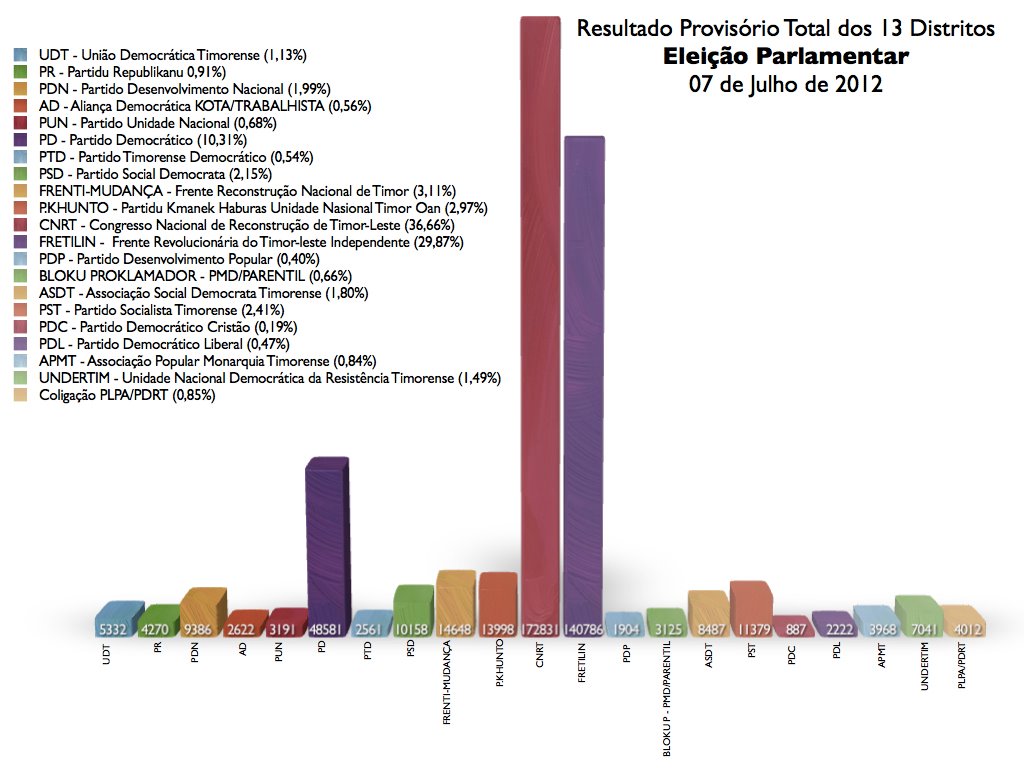
2012 Parliamentary election result

The 2012 Parliamentary election result - STAE

The United Nations congratulates peacefull and fair election in Timor Leste


U N I T E D N A T I O N S       


New York, 7 July 2012 - Statement Attributable to the Spokesperson for the Secretary-General on the parliamentary election in Timor-Leste

... The Secretary-General congratulates the people, Government and political parties of Timor-Leste for the peaceful and orderly manner in which today's parliamentary election was held.

The Secretary-General commends the national authorities, particularly the Technical Secretariat for Electoral Administration and the National Electoral Commission, for organizing and supervising the polling, and the National Police of Timor-Leste for maintaining a stable environment throughout the electoral process.

The Secretary-General trusts that the same peaceful and democratic spirit which characterized today's elections will prevail during the vote counting and subsequent announcement of the election results.

The successful conduct of the 2012 presidential and parliamentary elections further consolidate the progress made by Timor-Leste since the restoration of independence ten years ago. The Secretary-General reiterates the United Nations’ continued commitment to supporting Timor-Leste in its efforts to build a peaceful and prosperous future.

Jul 2, 2012

Digicel and TELIN receive official license


TELIN sign a contract with RTTL - EP
Digicel Sponsored a Football League in TL - 2010

*Diario Nacional, July 3, 2012 language source: Tetun

Minister for Infrastructure Pedro Lay affirmed that the Timorese Government
had officially provided official license for the Digicel Pacific Limited and
Telkomsel International from Indonesia (TELIN) to invest in the
telecommunication sector in Timor-Leste.

“The result of the tender we held recently won by Digicel Pacific Limited
(Digicel) a company from Ireland and Indonesian Telekom International
(TELIN),”

“They will compete with Timor Telecom (TT) in the national market,” Minister
Lay said.

He said the Government had recently end the contract of TT not to monopolize
the telecommunication in the country, adding that the Government implemented
liberalization law in order to allow other telecom companies coming to
invest and compete with TT.
Source: Alberico Junior

Jul 1, 2012

Xanana Gusmao calls on old generations to unite for developing TL


*Timor Post, July 2, 2012 language source: Tetun

President of the National Congress for the Timorese Reconstruction (CNRT)
Kay Rala Xanana Gusmao has called on the old generations to unite to better
develope this country.

He also called on all the people and the political parties which had the
same thoughts to unite and develop this country prospering the people in the
future.

“We will be together with other parties to rule this country onward for the
people’s better future, for the veterans and for the young people’s lives,”
Gusmao said.

Gusmao made the statements yesterday during his political campaigns which
were held yesterday in Dili.

It is important for the young people to unite and contribute to the
security, peace and stability maintenance in the country.

President TMR to participate CPLP summit in Mozambique


*Independente July 2, 2012, language Source: Tetun

President of the Republic Taur Matan Ruak (TMR) has given a green light to
participate in the Portuguese Language Speaking Countries (CPLP) summit in
Mozambique this month.

Former President Jose Ramos Horta made the comments after holding the
meeting with TMR at the palace of the president in Dili.

He added although President TMR had promised to the people of the country
that he would not hold overseas visit, but CPLP summit was important for the
people of the country.

“CPLP meeting is very important; therefore President TMR should participate
to deliver his speech on Guinea Bissau’s crisis,” he said.

Source: News Translated by Alberico Junior

Jun 30, 2012

Timor-Leste will license Digicel and Telin to enter the telecommunications market « Government of Timor-Leste

Timor-Leste will license Digicel and Telin to enter the telecommunications market « Government of Timor-Leste

Fretilin e CNRT negam coligação e existência de governo "sombra"


29 de Junho de 2012, 21:00
Díli, 29 jun (Lusa) - O Conselho Nacional da Reconstrução de Timor-Leste (CNRT) e a Frente Revolucionária do Timor-Leste Independente (Fretilin) negaram hoje a existência de uma coligação pós-eleitoral e de um "governo sombra" divulgado na imprensa.
A imprensa timorense divulgou um alegado governo de coligação entre os dois partidos, liderado pelo atual primeiro-ministro, Xanana Gusmão. O presidente da Fretilin, Francisco Guterres Lu Olo, era apontado como presidente do parlamento nacional.
O alegado governo "sombra" incluia também os nomes de Rui Araújo (Fretilin) e da atual Procuradora-Geral da República, Ana Pessoa, nos cargos de vice-primeiros-ministros.
O líder do partido União dos Filhos da Montanha (Kota), Manuel Tilman, aparece como presidente do Tribunal de Recurso.
"Isso é mentira", afirmou à Lusa o secretário-geral do CNRT, Dionísio Babo.
A Fretilin também recusou, em comunicado divulgado à imprensa, a existência de qualquer governo "sombra".
Timor-Leste realiza eleições legislativas no próximo 07 de julho às quais se candidataram 21 partidos e coligações.
Responsáveis da Fretilin e do CNRT afirmaram em entrevistas à Lusa estarem disponíveis para fazer coligações pós-eleitorais caso não vençam o escrutínio com maioria.
MSE.
Lusa/Fim
Source: www.sapo.tl

Jun 28, 2012

No clean sweep

The Economist

A poor country with a tragic past argues over its nest-egg
Jun 30th 2012 | DILI | from the print edition

AT THE crack of dawn brigades of streetsweepers fan out across Timor-Leste’s capital, Dili. In smart blue overalls and armed with brooms, they ensure that Dili’s main streets can vie for cleanliness with Singapore’s or Tokyo’s. It is a project designed to provide jobs for the city’s many unemployed. And it works. Despite the many burned-out buildings, the town feels less depressing than it did. But just off the main roads, the squalor of extreme poverty still prevails, and large families live in tiny shacks without water or sanitation.

To hear the parties campaigning ahead of a parliamentary election set for July 7th, such poverty will soon be a thing of the past in this country of 1.1m people. Setting up a political party is easy. The fact that each one gets a state subsidy helps explain why more than 20 mostly tiny parties will contest the 65 seats. Only two have a chance of winning: the Congresso Nacional de Reconstrução de Timor-Leste (CNRT) led by Xanana Gusmão, a charismatic former independence leader and now prime minister, and the Frente Revolucionária de Timor-Leste Independente (Fretilin), the party under whose flag the independence struggle was fought. Neither is likely to win an absolute majority.
Fretilin, now five years in opposition, has a hard core of support yielding up to 30% of votes. The CNRT aims higher. It hopes its huge expansion of public spending, including cash-transfer schemes, has bought it popularity. The budget has increased more than fourfold since 2008.
If it fails to win outright, the CNRT will reluctantly consider a coalition. But Mr Gusmão has tired of the struggle to keep his present five-party coalition on the rails. Meanwhile his government has been accused of widespread graft. His former finance minister, Lucia Lobato, was sentenced in June to five years in jail.

The wild card in the election is José Ramos-Horta, president until May and a former resistance leader-in-exile. Since his defeat in the presidential election earlier this year, he has tried to counterbalance the CNRT by supporting two smaller parties. He has made it clear that he hopes to see Fretilin included in the next government.

Much is at stake. Just this month a mass grave, holding dozens of bodies, was discovered in, of all places, Mr Gusmão’s garden in Dili. They had apparently been there since the bloodshed surrounding the end of Indonesia’s occupation in 1999, or even its invasion in 1975. Mr Gusmão himself has always said that economic development should trump the settling of old scores. Since then Timor-Leste has become rich, at least on paper, from oil and gas, with the income kept in a Petroleum Fund, which has swollen to $10 billion. Mr Gusmão wants to use the fund for a big development plan covering multi-billion-dollar infrastructure projects, including highways, new ports and an airport.
Mr Gusmão has been funnelling money from the fund to buy off influential groups of resistance veterans with generous pensions, and with development projects in rural areas seen as staunch during the occupation. Lucrative contracts to build the power grid in the countryside were awarded to the most loyal veterans.

But Mr Gusmão’s critics, among them Fretilin’s secretary-general, Mari Alkatiri, say his government has been spending unsustainably, bringing high inflation­an annual rate of nearly 18%­and risking emptying the Petroleum Fund within ten years. They also argue that the huge expenditure has benefited only a fifth of the population, even as over half still live in the sort of poverty seen in the poorest parts of Africa. Malnutrition among children is common, maternal mortality is one of the highest in Asia, and infectious diseases such as tuberculosis and hepatitis-B are endemic.
Despite all this, a lavish ceremony was staged at midnight on May 20th to celebrate the tenth anniversary of independence and to inaugurate the new president, Taur Matan Ruak, a former guerrilla leader and armed-forces chief. He will play a crucial role in forming a widely accepted government after the election.

If the vote goes smoothly, the United Nations will end its assistance mission and pull out its people, including 1,200 UN police, this year. A symbolic key to all the property it will leave behind has already been solemnly presented to Mr Gusmão. This will be the UN’s second withdrawal. After it left in 2006, a breakdown in security nearly led to civil war. Many Timorese are still nervous about the potential for political strife after the election. But the smooth conduct of this year’s presidential poll has built some confidence that democracy in Timor-Leste has matured enough to shake off its violent past.

Jun 26, 2012

Horta agrees to be investigated and waits for Gusmao’s action


*Independente, June 26, 2012 language source: Tetun

Former President of the Republic, Jose Ramos Horta said that he agreed with
the request of Prime Minister Xanana Gusmao to hold an investigation into
his office and is waiting for PM Gusmao’s action.

Horta said that no matter to hold investigation into his former office, but
the investigation should also be held into the office of the Prime Minister,
tribunal and other Government’s institutions.

“Not only hold investigation into the office of the (former) president, but
also investigate the office of the prime minister, tribunal and others, I
agree with this investigation,” Horta said.

He added that it was important to hold investigation into all the state
institutions as it was a way of guaranteeing transparency and accountability
in the country.

Horta added that he was ready to be investigated because the United Nations
Development Program had also held an investigation into the use of power at his former office (President Palace).


*Horta supports creation of national unity government
*Independente, June 26, 2012 language source: Tetun

Former President of the Republic Jose Ramos Horta said the time had come for the historical leaders to unite and to form a national unity government to
better develop this country.

“I agree with this and I am ready to support national unity government and I
think climate (situation) in our country is positive for this,” Horta said.

Horta made the statements at the International Airport of Nicolao Lobato in
Comoro, Dili after returning from Brazil.

*News translated by Alberico Junior 

Jun 25, 2012

Timorese Politics: lessons from Cyberspace war


By: Acacio Angel

When one sees two Chinese together, one can guess what they must be talking about: business and money. Guess what two Timorese would talk about but Politics and power. The political discussion flows from two people to families, from groups to parties and them from media to online media.

Timor Leste is probably one of the countries in the world that discusses most of its political issues on social networking medias like Blogs and Facebook. As early as 2005/6, several Bloggers like Timor Online, ForumHaksesuk and Timor Lorosae Nacao started expressing their political opinions through blogging. Others simply use Facebook groups to express their ideas or supports to their preferred political parties. Another group are Bloggers who provide a neutral and objective opinion or arguments of the institutions they represent. Unlike blogging, which has certain controlling mechanism and close to discussion, Facebook users take a few step further from discussion to insults and purging of emotional baggage in public spaces. Could any good thing come out from the different ways of communicating opinion?

Regardless of the politics and its outcome in the July 7th parliamentary election, the cyberspace war is worth paying attention to. With high emotion and uneducated political opinion involved, this cyberspace war avoids people from the actual confrontation or face-to-face fight. In an actual face-on fight, there is no more reason, argument and logic but emotions. The online fight provides opinions and emotional state people are up to without having to actually stepping on others’ toes. The online antagonism offers opportunities for people from far distances and across various political opinions to express their real lives nightmares and negative experiences with certain political leaders without physically hurting others.

In a country like Timor Leste where there is weak conflict management education, except a single person show of conflict management, online social networking is an option for young generation to enjoy freedom of expression. They are free to express their preference to a Party or hate them without having to stretch their arms and hurt another. It turns down the belief that Timorese solve problems with violence and not with dialogues. The online rivalry is a modern concept and available to small group of people where many youth and politicians are in the groups and it slowly changing the violent mentality that were products of the previous society.

But this freedom of expression and model of conflict management is too subjective and a venue for the escapee. There is more gossip than facts, opinion than arguments. Instead of insulting the political figures or parties, both bloggers and Facebookers should involve more healthy discussion on relevant issues facing the country, the party programs to address the issues and the credible leaders to fight them.

The future generation should be debating within those lines because TL is such a small country that has more political parties but lack of political idealism to lead the country forward. The freedom of expression which was hard-won by our deceased heroes should be excercised in the context of development and prosperity. When there is no substantial discussion on political idealism (not radicalism) and concrete plan, the country could only create more political opportunist groups that want only power but not to be responsible to any wrongdoing or mismanagement of the state’s funds.

With the presence of a more balanced social groups, objective and investigative bloggers like Lao Hamutuk, Luta Hamutuk, Forum Haksesuk, Tempo Semanal and Renova Timor, facebook groups could learn the lesson of thinking critically, objectively and logically which produces more constructive critics and accustomed to vibrant opinions.

The presence of modern social networking could help building a better and prosperous Timor Leste for all. When the communication technology is properly used, the online communications could be a powerful tool used to influence policy makers and hold them accountable to their deeds. A better Timor Leste could start from online social networking.


Jun 24, 2012

GOPAC calls on investigation into road rehabilitations and Comoro Bridge building

Fernanda Borges

GOPACGlobal Organization of Parliamentarians Against CorruptionTimor-Leste


Press Release

Rehabilitation of Dili Roads and new Comoro Bridge


The Global Organization of Parliamentarians against Corruption (GOPAC) in Timor-Leste has received information about possible improprieties in the recent rehabilitation of Dili roads and construction of new Comoro Bridge awarded by AMP government to Consorsio National de Construcao Timor-Leste (CNCTL). If the allegations are true, the award was made a as a single-sourced procurement, without the proper tender process required for an award of this size. As such, the award potentially violates Timor-Leste's state financial management law and legal regime of procurement processes. Given the potential criminal nature of the allegations, GOPAC calls for an urgent investigation into this matter.

The information received by GOPAC alleges that the rehabilitation of Dili roads and construction of the new Comoro Bridge by CNCTL was done without a properlcy approved budget, and not based on a design plan. In addition, information received alleges that the construction was lacks rigorous technical specification and a total estimation of cost of the project. In evidence received by GOPAC, the CNCTL has indicated that cost to date is already in the order of US$ 45 million dollars.


GOPAC also notes that this construction of Dili roads and proposed construction of the Comoro bridge was never included in the state budget, and that CNCTL was rather requested to execute the project without a prior signed contract with the government.


As a result, it appears as if the project was executed solely based on CNCTL's own project cost estimation. If the information received us correct, it appears that on May 31, 2012 CNCTL, submitted an invoice of US $ 16 million dollars (out of a total of allegedly close to of US$ 45 million) to the government through the ministry of infrastructure.


GOPAC therefore requested that these allegations be investigated immediately by the Anti-Corruption Commission (CAC), Prosecutor-General (PG) and the High Court of Account. Meanwhile, GOPAC also requested the National Development Agency - Agenda Dezenvolvimento Nacional (AND) to provide to GOPAC the following documents:


- Approved design and contract documentation of rehabilitation of Dili roads and construction and new Comoro bridge project, including complete costing projections- Signed contract between government and CNCTL


- Information on state budget items which indicate that the budget as been allocated for rehabilitation of Dili roads and reconstruction of new Comoro bridge


- Information on all items that has been paid by the government to CNCTL in regards to these projects


Source: ETAN news

Jun 21, 2012

Civil society challenges Gusmao on state institution audit

Mericio Akara - The Director of Luta Hamutuk


Independente, June 21, 2012 language source: Tetun
Director for Luta Hamutuk Mericio Akara has challenged Prime Minister Xanana Gusmao to send or allow independent investigators for auditing or investigating his office and all the ministries.


He said that the objective of the investigation was to uncover the result of the budget execution within five years.


"The investigation should also be made into the Office of the Prime Minister and all his ministries, including the National parliament, because they spent state money," Akara said. 


Akara made the statements regarding Prime Minister Xanana Gusmao had recently sent a dispatch to the State's Inspector General to the former president of the republic Jose Ramos Horta.

"Xanana orders audit of Horta"

Xanana Gusmao during a Party Campaign - 2012


Jornal INDEPENDENTE


The Inspector General Francisco Carvalho has received a dispatch from Prime Minister Xanana Gusmao, requesting an audit of the work of the work of former President of the Republic Jose Ramos-Horta during his five year term.


The Dispatch from Prime Minister Xanana was issued on 18 June current requesting an inspection and audit of the office of the President of the Republic.

"We were requested by the Prime Minister Xanana Gusmao to undertake an inspection and audit of the office of the President of the Republic," said the State Inspector General  Francisco Carvalho to Independente at Delta Nova reception centre on 19 June current.


The inspection and audit will be undertaken with respect to the execution of the budget and work done by former President of the Republic Ramos-Horta.

"It will include former President of the Republic Ramos-Horta's work there, to rectify anything that may not have been done properly," said Carvalho.


To execute the request of the Prime Minister, Carvalho said, he has already set up a team to discuss a plan properly before implementing it.

Carvalho said that inspections and audits of the office of the President of the Republic are normal and had been done also with respect to the first President of the Republic.


Jun 14, 2012

Ways To be Responsible Citizens

Election in Timor Leste

By: Acacio Angel

Lao Hamutuk posted essential questions not only for political parties but voters to consider. should citizens continue to act like they know nothing and that they could always be manipulated by the politicians? the answer is not yes or no. 

Think this way. Regardless of which party wins the election, people will remain the same. There will be new government formed and the others  be oppositions while ordinary people remain ordinary.  This happens everywhere in the world. Politicians manipulate voters to get to power and once thay are in power, they can do whatever they want without having to deliver their promises during the campaigns; the voters are simple means to small groups' end. So sad. Voters can turn this arround.  


Voters can change the way Timorese are practicing democracy and doing politics. They have to question  the political parties on their vision and action plan for the country in the coming 5 years and the impacts to TL as a country in the future. Political parties that do not have clear plan on the issues of the country's economy growth, self reliance, poor education, unemployment, security, elderly care, justice system and moral lives and foreign policy should not be allowed to enter campaign in the election. However, simple people cannot block the political parties because the constitution protects them.

The best way to avoid the many misleading political parties is not to waste your votes during the election. In other words, vote big political parties that are well established and have the competence and capacity to rule the country towards steady economic growth and bring about prosperity. Voting to such parties are ways to be responsible citizens and call big parties to be accountable to their promises.

This is the way we show quality in practicing democracy and bring back value to doing politics. Citizens have to be responsible to their votes for you get what you vote for. Less than this, our doing politics gets nowhere and TL remains where it is. 

It is your choice. 

Questions for Voters to ask Political Party Campaigns


13 June 2012

Questions for Voters to ask Political Party Campaigns

Atu hare'e blog ida ne'e iha Tetum, hili iha ne'e.
To support citizens’ participation in the election, La’o Hamutuk has published a pamphlet with questions for voters to ask each political party. You can download it as a Tetum PDF (or English) or find more information about the electoral process on La’o Hamutuk’s website.

La’o Hamutuk is a Civil Society Organization which monitors and analyzes the development process. In July, you will vote for Members of the National Parliament. This process is a democratic path to determine your future and that of the next generation.

The political campaign has already started, and we think that your participation will help future leaders to decide on good and appropriate policies for Timor-Leste’s actual situation.In addition to helping you understand each party’s program for the next five years, this will also help you vote wisely, according to your conscience.

Therefore, we are distributing some questions to help you participate in the campaign dialogue process. Voters can ask these questions of political parties when they campaign in your communities. We suggest the following questions:

Economy
  • At present, half of our domestic economy and nearly all state activities are paid for with petroleum revenues. What policies will your political party undertake to continue state services and sustain people’s lives when the oil is used up and the Petroleum Fund is empty 12 years from now?
  • At present, more than half of the state budget is spent on physical infrastructure, especially electricity. Only a little is allocated for human resources, like education and health. Do you think it is good to continue these priorities, or to develop the capacity of Timor-Leste’s people to carry the nation forward?
  • Ten years from now, our youth population will be much larger, and unemployment may be higher than it is today. What policy will your party propose to help Timor-Leste deal with this program, and which human resources will you prioritize to develop this nation?
  • Timor-Leste’s Government just began to borrow from overseas, and there is a plan to borrow much more to finance the National Strategic Development Plan. How can Timor-Leste pay back the debt, when our oil and gas is gone?
  • At present, the Government prioritizes the Tasi Mane Project on the South Coast, which will rely on the Greater Sunrise gas field. If we cannot bring the Greater Sunrise pipeline to Timor-Leste, what will underpin this project? What does your political party think about this investment or spending of the people’s money?
  • If Government actually develops this Tasi Mane project, does your political party think that the project will provide work for many Timorese people, or benefit rich people more than the poor? What is your party’s approach to the participation of women and men in this project?
Governance and Justice
  • During its illegal occupation, Indonesia killed nearly 200,000 people, and after independence impunity continues to prevail for Indonesian generals involved in crimes against humanity in Timor-Leste. Does your party think it is important for perpetrators to be brought to court? What will your party do to end this impunity?
  • Timor-Leste has not yet ratified the International Convention for the Protection of All Person from Enforced Disappearance. Does your party think we should sign and ratify it? If so, how do you think we should implement this Convention?
  • Corruption is an obstacle to development, especially in countries whose state budget depends on oil revenues, like Timor-Leste. What policies will your party propose to prevent corruption, including in Public Institutions and state-owned businesses?
  • At present, Timor-Leste is trying hard to join ASEAN, but nearly all ASEAN countries supported Indonesia’s illegal occupation of Timor-Leste for 24 years. What will your party do to help stop human rights violations within ASEAN, such as in Burma and West Papua?
Agriculture
  • Former President Ramos-Horta vetoed three laws about access to land, because he saw that these laws could violate the rights of ordinary people. What will your party’s policy be to protect and ensure small people’s rights to access land?
  • What policy will your party propose to develop a productive, sustainable economy, such as agriculture, to reduce our economic dependence on exporting nonrenewable resources? How will you reduce imports of food and basic necessities, so that Timor-Leste can achieve economic and food sovereignty?

Jun 11, 2012

Timor Justice Minister Consider Appeal

ABC Radio Australia
Connect Asia


Updated 11 June 2012, 14:01 AEST

East Timor's former Justice Minister has two weeks to decide whether she will appeal against a conviction for misadministration of funds, or else face jail.
Timor Justice Minister considers appeal (Credit: ABC)

On Friday, Lucia Lobato was sentenced to five years prison, but was found not guilty of three other charges including corruption, the abuse of power and falsification of documents.

Ms Lobato's lawyer says the prosecution presented no evidence to support the charge and he will encourage her to appeal within the 15 days period allowed for lodging a challenge.

Correspondent: Karon Snowdon

Speaker: Cancio Xavier, lawyer for East Timor's former Justice Minister Lucia Lobato

SNOWDON: In the months leading up to East Timor's presidential election a scandal erupted that shocked this small island state.

It was used by critics to accuse the government of Prime Minister Xanana Gusmao of gross corruption.

Justice Minister Lucia Lobato was suspended by the parliament because she was facing serious charges.

Thirty-six of the 65 members of Parliament voted to suspend her.

Now she faces the prospect of five years in jail, the mid point between a possible two to eight year sentence.

The court found her guilty of one of the four charges against her -- the misappropriation of Ministry funds.

Lawyer Cancio Xavier says the sentence which includes a hefty fine is a heavy one, and was arrived at he says, without evidence.

XAVIER: No corruption and no power abuse, and then no falsified documents. But during the court process, we never got to any evidence.

SNOWDON: Lucia Lobato was implicated in a case of collusion involving government tenders for contracts worth one million dollars. Ms Lobato was elected to East Timor's first Parliament in 2001 and appointed Finance Minister in 2007. She is a member of the Social Democratic Party and was the sole female candidate in East Timor's 2007 Presidential election.

Cancio Xavier says Ms Lobato is traumatised by the case and doesn't want to appeal. Her lawyer hopes to convince her to change her mind within the 15 day limit to avoid jail.

XAVIER: Today, maybe she's traumatised regarding this conviction, so she said to us, she doesn't want to make an appeal. But we have advised her after today, because when we make appeal fifteen days later, when we appeal against this decision. Automatically after the fifteen days, she'll go to jail.

SNOWDON: And would you be confident of winning the appeal?

XAVIER: Yes, of course, of course!

SNOWDON: Cancio Xavier, Lawyer for East Timor's Justice Minister Lucia Lobato,

Another five government ministers have been investigated by East Timor's Anti-Corruption Commission

Jun 7, 2012

Campaign Fever for the July 7th Election

CNRT Party Campaign 
Lu-Olo and Dr. Alkatiri Campaign door-to-door in Villa Verde


Jun 1, 2012

President of Republic conducts first meeting with political parties


President Taur Matan Ruak Inspecting the Military during the 20th May Celebration - Photo: Fundasaun Mahein


Dili, 30 May 2012: President of Republic, Taur Matan Ruak, today, at the Presidential Palace had the first meeting with the political parties that will compete in the upcoming Parliamentary election.
The objective of the meeting was to discuss concerns and suggestions before the campaign starts on June 5th, 2012.
The Head of State reminded the leaders of the parties that the upcoming elections is another test for the people of Timor-Leste and so, they have to  be united and ensure the election process is smooth like the Presidential election of 2012.
President urged the leaders of the political parties to start identifying the areas of possible conflict during the campaign and also to avoid any conflict.
The President said that the population in rural areas lack  information about the election process, therefore, urged the political parties to strengthen civil education, observation, and also involve media in campaign activities.
According to the agenda of the National Election Commission, there are 18 political parties and 3 coalition parties that are ready to compete on the upcoming Parliamentary election. The campaign will be start on June 5th and last till 4th of July 2012.

Source: http://presidentetimorleste.tl/